
POSEIDON
Earth Observation and Artificial Intelligence for Maritime Pollution Detection, Monitoring and Compliance
The marine ecosystems are constantly being added with more pressure, as the globally increasing maritime traffic results in increased pollution from oil spills, vessel emissions, sewage and litter. Illegal fishing, discharges and waste dumping activities, enhance the need to develop and use innovative tools and methods for detecting, characterising and attributing to their source such environmental offences.
The Horizon Europe POSEIDON project, Pollution Observation from Space: Environmental Imaging for Detections in the Oceans & Nearshore, is funded by the European Union and comprises ten partners from Europe, Canada and Asia, in order to exploit the recent advances in Earth Observation and Artificial Intelligence, and creates solutions for supporting and strengthening the implementation of the MARPOL regulatory framework, the Ship Sourced Pollution Directive and the European Union Environmental Crime Directive.
“The project intends to leverage optical and radar-based satellite technology for improving services for identifying oil spills, detecting oil spills in sea ice conditions, and detecting and identifying chemicals, sewage, garbage, emissions, and other pollutants released by ships at sea.”
How?
The services for identifying and detecting oil spills and chemicals in the oceans, sewage, garbage, gas emissions and other pollutants released by ships at sea, including sea ice conditions, are improved by leveraging and integrating various technologies, such as multi-sensor satellites, vessel tracking information, in-situ measurements, environmental models and AI-based analytics.
The five international test sites that have been selected, Elefsis Gulf in Greece, Strait of Gibraltar, Maldives, Singapore Strait and Arctic regions, demonstrate these capabilities as they not only face unique and complex environmental conditions, but they also address various challenges that may have societal and economic impact if not identified and tackled in time.
POSEIDON showcases how the utilisation of different data sources can be incorporated into operational workflows to strengthen the prompt environmental crime detection and improve the situational awareness. Moreover, it identifies technical, operational, and institutional challenges and supports developing a stronger collaboration between enforcement authorities and the scientific community, aiming to contribute to the wider uptake in decision-making.
Work packages
-
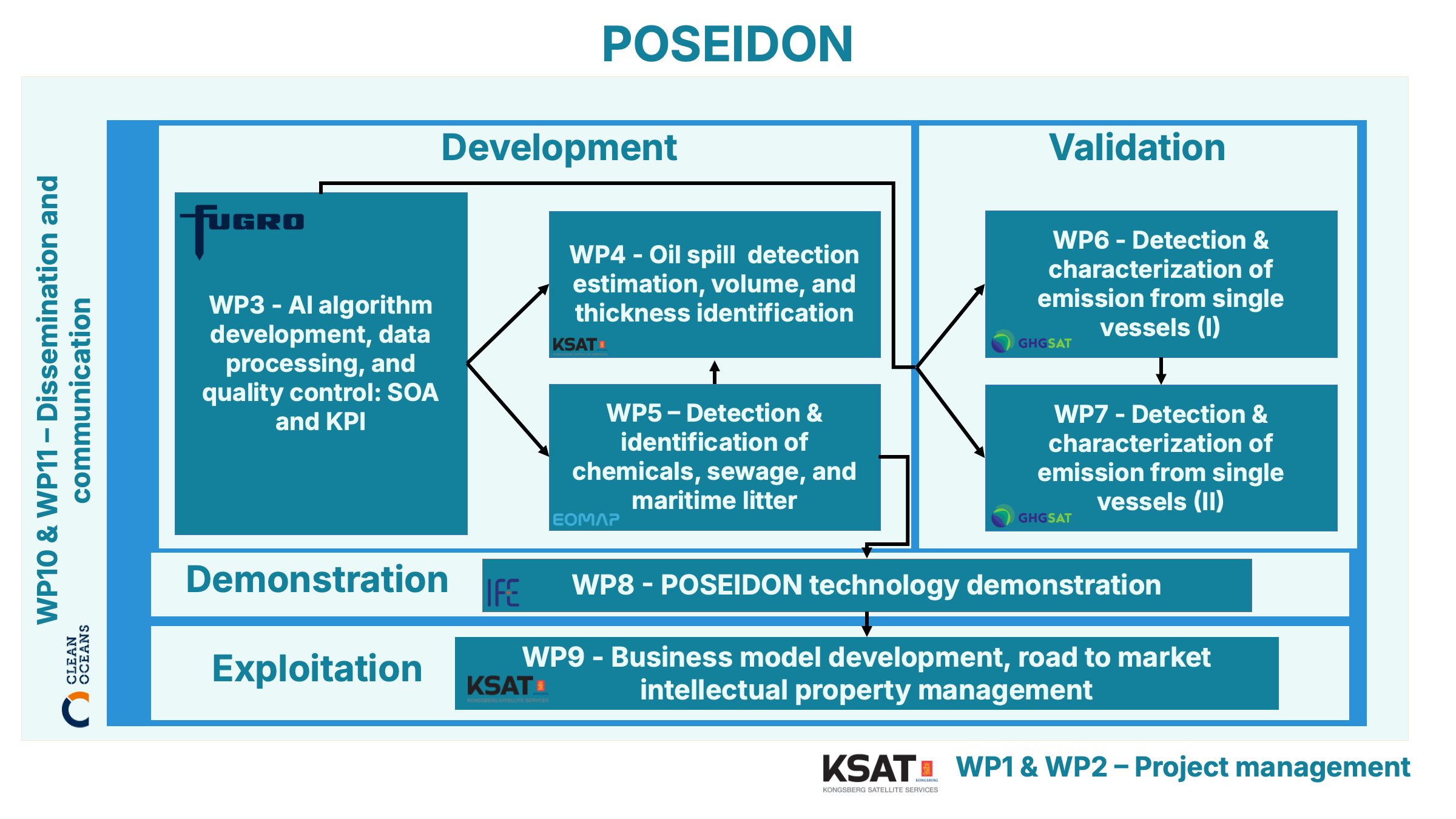
Ensures POSEIDON gets off to a prompt start and runs with a flexible structure throughout the project. Responsible for coordination, reporting, and liaison with the European Commission, as well as risk management and administrative compliance. Led by KSAT.
-
Lays the methodological foundation for the project by assessing the state of the art, developing AI and modelling approaches, and defining key performance indicators (KPIs) to track progress. The outputs feed directly into the technical work in WP4, WP5, and WP6-7. Led by Fugro.
-
Develops and improves methods for detecting oil spills from satellite, estimating volume and thickness, and adapting detection to challenging conditions such as sea ice. Also includes models to reconstruct spill origin and predict future spread, validated through field campaigns. Led by KSAT.
-
Develops Earth observation, AI, and proxy-based methods to detect and monitor chemicals, sewage discharges, and marine litter along coasts and at sea, validated against high-resolution reference data. Led by EOMAP.
-
Develop satellite-based methods to detect and characterise methane emissions from individual vessels, aiming for faster processing chains to support maritime regulation and enforcement. The second phase also explores the potential to detect sulphur and nitrogen oxides, with validation in controlled scenarios. Led by GHGSat.
-
Tests and demonstrates the methods from WP4-WP7 in real-world case studies across several locations, validated against in-situ measurements. Also develops a roadmap for future marine pollution monitoring beyond current MARPOL regulations. Led by IFE.
-
Develops a sustainable business model and a clear route to market for the project's results, including a market analysis. Also manages and protects intellectual property to support commercial success. Led by KSAT.
-
Ensures effective communication of POSEIDON's activities and results to relevant audiences through a dedicated dissemination and communication plan. Engages key stakeholders and contributes to EU initiatives on industry and policy recommendations. Led by NOSCA Clean Oceans.
POSEIDON project timeline
← swipe to see the full timeline →