
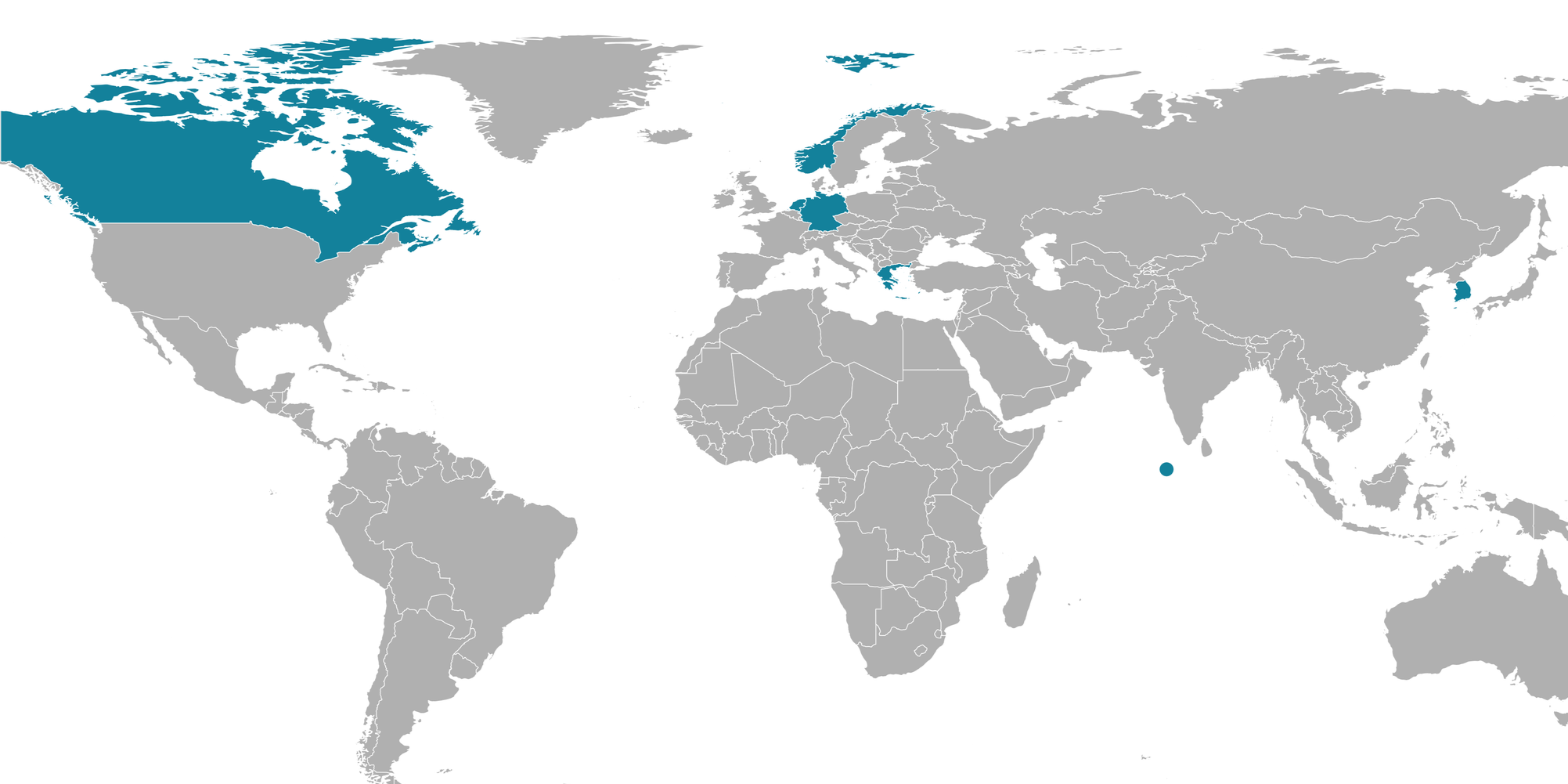
POSEIDON consortium
POSEIDON consortium is composed of 10 partners from 7 different countries. It includes private companies, research institutions, a university and a cluster.
Consortium partners
Kongsberg Satellite Services (KSAT)
Global leader in satellite-based maritime monitoring and ground station services, with over two decades of experience in oil spill and vessel detection. Since 2007, KSAT has been a key delivery partner for EMSA's CleanSeaNet service, providing near real-time satellite-based pollution and vessel detection across European waters. Project coordinator.
Institutt for Energiteknikk (IFE)
Independent Norwegian research foundation specializing in environmental technology, radioactivity, renewable energy, zero-emission transport with maritime focus, including the Horizon Europe project Source to Seas – Zero Pollution 2030. IFE brings expertise in contamination reduction from both land- and sea-based sources, including plastic, chemicals, and other pollutants. IFEs research provides clarity towards policy making.
Korean Institute of Ocean Science and Technology (KIOST)
South Korea's leading polar research institute, coordinating Korea’s scientific programs in the Arctic and Antarctic with expertise spanning marine ecosystems, climate change and geophysics. KIOST operates polar research stations and an icebreaking research vessel supporting extensive field research relevant to marine environmental monitoring.

Maldives Space Research Organisation (MSRO)
The first space organization dedicated to advancing the space sector in the Maldives, using Earth observation and satellite data to address climate resilience, maritime security and marine pollution. Although MSRO is non-governmental, they work closely with national authorities to build local capacity in space-based monitoring.
EOMAP GmbH & Co KG
EOMAP is a leading global provider of satellite-derived aquatic information in maritime and inland waters, serving the offshore industry and government agencies. Pioneering satellite-derived bathymetry and water quality monitoring, EOMAP relies on standardised physical models independent of scale, sensor type and location. With two decades of expertise, EOMAP supports governments, research institutions and businesses in monitoring and protecting aquatic resources.
Seoul National University (SNU)
Brings specialized expertise in satellite remote sensing for marine pollution monitoring, including AI-based oil spill detection, identification and drift prediction in polar waters. SNU's research helps distinguish real oil spills from look-alike phenomena, improving detection reliability, adding important expertise to POSEIDON. Based in South Korea.
Fugro
Global leader in geotechnical, geophysical and environmental marine services supporting safe and sustainable offshore operations. Fugro contributes expertise in environmental data collection, water quality analysis and ecological surveys to strengthen marine pollution monitoring. Based in the Netherlands.
GHGSat Inc.
Global leader in satellite-based detection and quantification of methane and CO2 emissions from industrial sites, operating a fleet of proprietary satellites capable of pinpointing leaks with high accuracy. GHGSat brings this expertise to POSEIDON to detect and attribute methane emissions from individual vessels. Based in Canada.
Clean Oceans
Norwegian innovation cluster with over 30 years of experience in oil spill technologies. Has extended this expertise to broader marine pollution challenges such as marine litter since 2017. Clean Oceans leads POSEIDON's communication, dissemination and stakeholder engagement activities.
Hellenic Centre for Marine Research (HCMR)
Greek governmental research institution specializing in marine and aquatic sciences, including marine pollution assessment and oceanographic modelling and forecasting. HCMR has extensive experience in European research projects and works closely with EMSA on marine pollution preparedness and response.